Institute of Engineering & Management
News & Achievements
Introduction to Raspberry Pi3
[gallery columns="1" size="large" ids="4041"]
[gallery columns="1" ids="4042"]
Read more
May 2, 2017
Faculty Development Programs
DEMONETISATION & ITS IMPLICATIONS: PAST AND PRESENT
Prof. P.K. Banerjee
8.12.2016
Demonetisation is a radical monetary step in which a currency unit’s status as a legal tender is declared invalid. The lecture discussed what demonetisation is all about and why it has been implemented. It also covered other relevant topics such as:
History of Demonetisation
Its Implications
Benefits of Demonetisation
Drawbacks of Demonetisation
Demonetisation and what has gone wrong
Can demonetisation alone root out corruption and black money?
Read more
May 2, 2017
Faculty Development Programs
APPLYING FOR RESEARCH GRANTS TO DIFFERENT FUNDING BODIES
Prof. Rahul Baidya
3.12.2016
The lecture on “Applying for Research Grants to Different Funding Bodies” was delivered keeping in mind that many Faculty members are interested in applying to different funding bodies to apply for research grants. It also paved the way for young research scholars to think about pursuing research work in varied fields and how to go about getting financial support. The lecture covered the following topics
How Grant writing is an important part of your professional growth strategy.
Build individual credentials.
Build a track record of funding.
Work on teams with more experienced researchers
What the funder looks for:
High-quality research: an original contribution to knowledge in the field.
Outputs: what will be the impact of the research?
Academic record: evidence of research potential
Approaching funding agencies:
Basic information such as names, addresses, contact details, present occupation, Present employer /CV/information about educational background is often needed
Background questions to approach grant applications with
Selecting a funding agency
Constructing an application framework
Grant application contents checklist
Guidelines for statement of project methods
Literature review and study questions
Research Methodology:
What methods are to be used in the research?
Why have they been chosen?
How will you set about answering the questions?
Are the research aims clear, can they be realized?
Funding opportunities for Science and Engineering Research Board (SERB) under DST
Funding opportunities of West Bengal DST under R&D Project
Funding opportunities of CSIR Research Grants
Funding opportunities under University Grants Commission (UGC)
Current call for proposals in Specific Domain
Read more
May 2, 2017
Faculty Development Programs
RENEWABLE ENERGY STORAGE AND INTEGRATION – THE ROADMAP AND TECHNICAL CHALLENGES
Prof. Ankur Bhattacharjee
9.12.2016
Govt. of India has announced a target of 175 GW Renewable power project by the year 2022 under “Jawaharlal Nehru National Solar Mission” (JNNSM). Looking at the projected plan, it is necessary to think about the future impact of large scale penetration of Renewable Energy (RE) sources into the existing grid. The Grid end problems (Voltage and frequency fluctuation) are classified in to two major categories;
1. Low voltage distribution grid (Weak Grid condition) problem,
2. National grid problem.
Optimized interface of energy storage with the RE sources is therefore a strong point of interest for the new age research and development. Different energy storage technologies have been analysed here for RE application specific choice of energy storage. Depending upon the power management and energy management criteria, the battery storage technology is considered suitable. There are existing battery technologies like Lead acid, Li-ion, NaS which are established as off grid back up power supply. But the new generation Redox Flow batteries claim to be the most suitable storage solution for large scale grid tied Renewable power system. Among the flow batteries, Vanadium Redox Flow Battery (VRFB) appears to be most acceptable due to its independent scalability of Power and energy capacity, very long lifecycle and deep discharge capacity. To implement the optimized battery storage system with RE sources, an efficient battery management system (BMS) is of high demand. There are significant battery internal parameters like; state of charge (SOC), battery temperature, internal impedance, thermal aging, and electrolyte flow rate (for VRFB) need to be taken care of to design an efficient BMS to enhance storage lifetime and overall plant efficiency.
[gallery columns="1" ids="4028"]
Read more
May 2, 2017
Faculty Development Programs
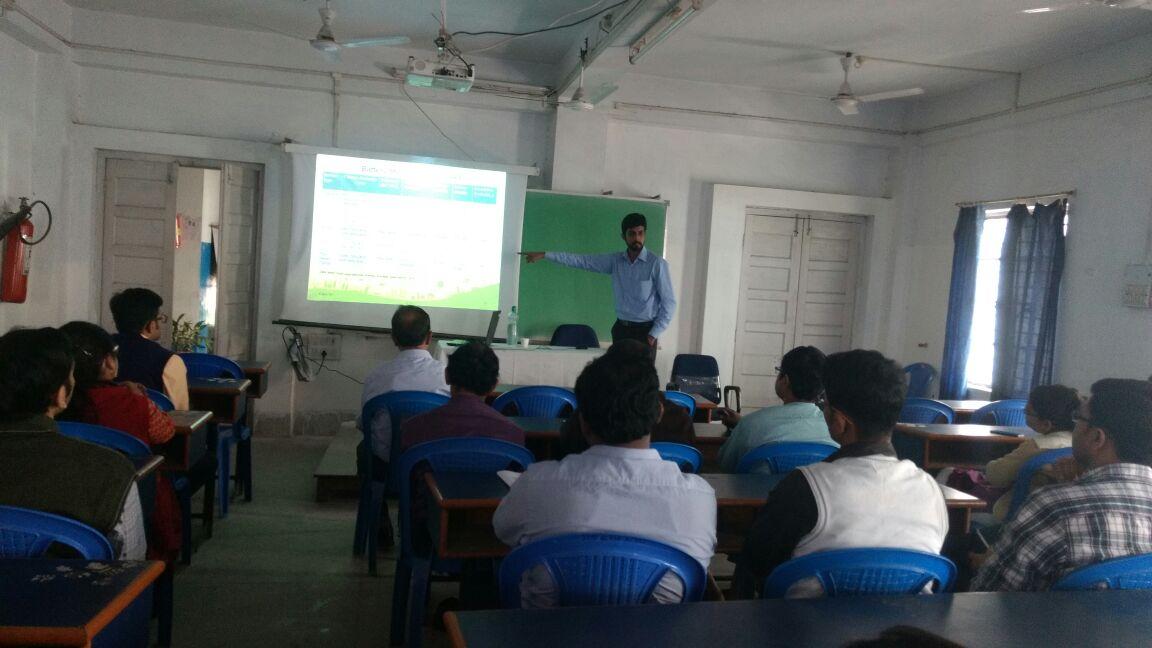
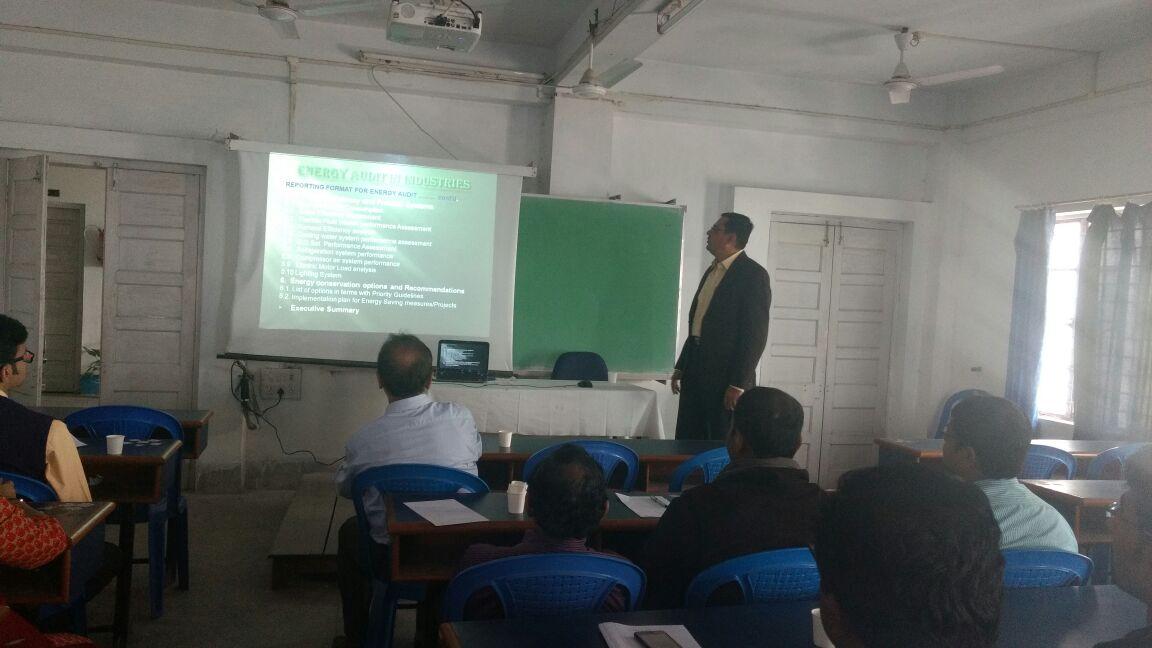
ENERGY AUDIT OF INDUSTRY
Prof. Avijit Bandopadhyay
9.12.2016
Prof. Bandopadhyay spoke about a burning topic most prevalent in an industry. Energy audit is very much important now-a-days in industry. Energy audit is a process by which an estimate is made regarding the amount and cost of energy consumed and to search for ways and means to reduce the cost of energy consumption. It helps to quantify the energy usage at a site and highlights areas for potential savings and gives the data from which performance indicators can be derived. In a nutshell, a thorough cost-benefit analysis is to be conducted so as to potentially optimize the usage of energy in an industry. The main objective of energy audit is to quantify energy consumption for audit scope (site, area or item of equipment), identify practical energy saving projects and categorize savings in energy and monetary terms. The total cost of energy consumption for a period of time is calculated. Then the results are compared with the current factory standards and then corrective actions are suggested so as to efficiently use energy and save energy and hence cost. Energy audit is basically categorized as preliminary and detailed audit. Preliminary energy audit is a relatively quick exercise to: Establish energy consumption in the organization , estimate the scope for saving , identify the most likely (and the easiest areas for attention , identify immediate (especially no-/low-cost) improvements/ savings , set a 'reference point', identify areas for more detailed study/measurement and preliminary energy audit uses existing, or easily obtained data. Detailed energy audit offers the most accurate estimate of energy savings and cost. It considers the interactive effects of all projects, accounts for the energy use of all major equipment, and includes detailed energy cost saving calculations and project cost.
[gallery columns="1" ids="4025"]
Read more
May 2, 2017
Faculty Development Programs
Few glimpses of the cultural performance at Institute of Engineering & Management (IEM) Management House.
Date- 29th April 2017, 30th April 2017 & 1st May 2017
[gallery ids="4015,4016,4017,4018,4019,4020,4021,4022,4023"]
Read more
May 2, 2017
Fests, Other events, University Daily News
Press coverage in The Asian Age and Sanmarg, regarding game changing discovery of Prof. Dr. Satyajit Chakrabarti, Founder Director, IEM
Press coverage in The Asian Age and Sanmarg, regarding game changing discovery of Prof. Dr. Satyajit Chakrabarti, Founder Director, Institute of Engineering & Management (IEM) and Chancellor, University of Engineering & Management (UEM) regarding safety arrangement in a car for safety of women and also mentioning about the high quality autonomous drone project of Prof. Dr. Himadri Nath Saha, IEM-UEM group.
[gallery columns="2" size="large" ids="4011,4012"]
Read more
May 2, 2017
Awards & Achievements, Press Releases, University Daily News
A handled skateboard controlled by mobile app designed and developed by the students of the University of Engineering & Management (UEM), Jaipur.
A handled skateboard controlled by mobile app, with autonomous obstacle detection facilities, capable of traveling through traffic on roads, designed and developed by the students of the University of Engineering & Management (UEM), Jaipur.
[embed]https://www.facebook.com/uemuniversity/videos/1288164001290411/[/embed]
Read more
Apr 28, 2017
Other events, University Daily News
Opening of ISHRAE (Indian Society of Heating, Refrigerating and Air Conditioning Engineers) chapter at University of Engineering & Management (UEM), Jaipur.
ISHRAE, was founded in 1981 at New Delhi by a group of eminent HVAC&R professionals. ISHRAE today has more than 12,000 HVAC&R professionals as members and additionally there are 7,500 Student-members.
ISHRAE aims at---
i) Advancement of the Arts and Sciences of Heating, Ventilation, Air Conditioning and Refrigeration Engineering and Related Services.
ii) Continuing education of Members and other interested persons in the said sciences through Lectures, Workshops, Product Presentations, Publications and Expositions.
iii) Rendition of career guidance and financial assistance to students of the said sciences.
iv) Encouragement of scientific research.
[gallery ids="3867,3868,3869,3870,3871"]
Read more
Apr 27, 2017
Other events, University Daily News